
The New Apostasy: Western 'Values' & Global Backlash
- ISYPO Media

- Sep 9, 2025
- 5 min read
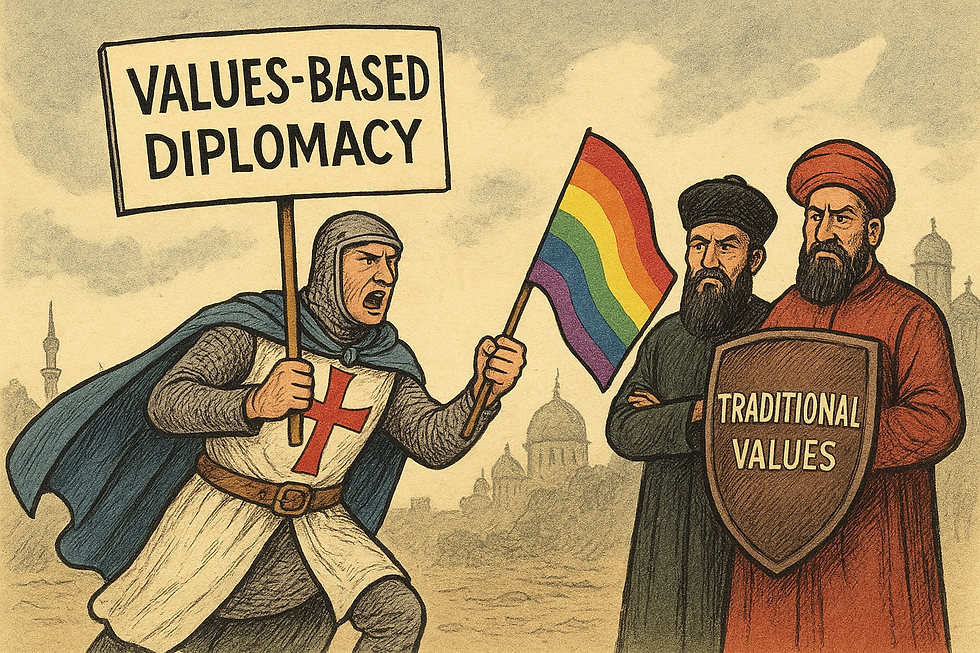
A quiet but major shift is redefining international relations, moving the battleground from trade and territory to values and identity. In boardrooms and foreign ministries across the West, a new doctrine has emerged, one that treats liberal secularism as a universal export product instead of a simple domestic arrangement. This moral crusade, often packaged as "values-based diplomacy" or the defense of "LGBTQ+ rights," is being met not with gratitude but with a fierce, doctrinally-driven counter-movement. We are witnessing the rise of a global culture war, where the West's well-intentioned but often ham-fisted advocacy is strengthening illiberal alliances and providing authoritarian leaders with a powerful tool to consolidate power: the defense of traditional values against a perceived neo-colonial moral imperialism. This is not an argument against the principles themselves, but a stark warning against their deployment as a blunt instrument of foreign policy. By failing to understand the deep religious and cultural doctrines they are challenging, Western nations are inadvertently forging a united front of nations that see themselves as protecting their civilizational identity from a new, morally corrosive form of hegemony. The result is not progress, but a dangerous polarization that undermines human rights and empowers the very actors we seek to pressure.
"Values-Based Foreign Policy" or Secular Evangelism
The trend is unmistakable. The European Union’s rigorous integration of human rights clauses into its trade agreements effectively makes market access contingent on adherence to a specific set of progressive values. Canada’s explicit championing of feminist and LGBTQ+ rights under the Trudeau government, including the appointment of an Ambassador for LGBTQ+ issues, frames these issues as non-negotiable pillars of its international identity. The Biden administration’s swift reversal of the "Mexico City Policy" and its emphasis on gender equality in its Interim National Security Strategic Guidance signal a return to making social liberalism a central tenet of American power.
The proponents of this approach see it as a moral obligation, a natural extension of domestic progress. However, to much of the world, this rhetoric echoes a familiar and despised history: the civilizing mission of colonialism. The language has simply evolved from "Christianizing the savages" to "liberalizing the bigots." This perception is not merely paranoia; it is rooted in a doctrinal understanding of society that the secular West often refuses to engage with on its own terms.
Doctrinal Counter-Doctrine? "Traditional Values" as a Sovereign Shield
The Western push has not gone unanswered. It has been met with a sophisticated, deeply-rooted counter-doctrine that frames "traditional values" as a matter of national and civilizational sovereignty. This is not merely political posturing; it is backed by coherent theological and philosophical frameworks.
The Russian Concept of "Russkiy Mir" (Russian World): Putin's Russia has expertly positioned itself as the global defender of "traditional Christian values" against a decadent and godless West. This is not an ad-hoc strategy but a calculated doctrine that merges Orthodox theology with political ideology. The 2013 "gay propaganda" law was not just a domestic policy; it was a statement of civilizational identity and a direct challenge to Western norms. It provides a moral justification for its actions, framing its aggression not as imperialism, but as a spiritual and cultural defense.
The African Context: Sovereignty and Anti-Colonialism: In numerous African nations, from Uganda to Nigeria, harsh new anti-LGBTQ+ laws are being passed with overwhelming popular support. Western condemnation and threats of aid cuts are not yielding compliance; they are triggering a powerful anti-colonial reflex. Prominent African leaders, intellectuals, and religious figures frame these laws not as hatred, but as a defense of African sovereignty and authentic cultural identity against Western imposition. They argue that the West's singular focus on sexual orientation is a distraction from more pressing issues like economic justice, making it seem hypocritical and paternalistic.
The "Family as the Cell of the State": This concept, prevalent in Catholic social teaching and echoed in various forms by Eastern Orthodoxy and Islam, posits that the traditional family is the fundamental, God-ordained unit of a healthy society. From this perspective, Western promotion of alternative family structures and gender ideologies is not seen as an expansion of rights, but as an attack on the very foundation of the social order. This is a doctrinal belief, not a negotiable policy preference.
The West's ethical failure in this arena is a profound lack of cultural and doctrinal humility. By operating on the unshakeable assumption that its progressive trajectory is the only legitimate path for all humanity, it commits a error of both strategy and ethics.
The approach treats deep-seated religious and cultural beliefs as mere "prejudices" to be overcome through economic pressure and public shaming. This is not diplomacy; it is secular evangelism, and it is just as unwelcome as its religious counterparts. It fails to recognize that for billions of people, their religious identity is non-negotiable and intrinsically tied to their national and personal sovereignty. By forcing a binary choice—adopt our values or face isolation—the West backs governments and their citizens into a corner, ensuring they will choose their identity and rally behind often-awful leaders who promise to protect it.
The ethical alternative is not silence in the face of persecution. It is a smarter, more respectful, and ultimately more effective approach: distinguishing between advocacy and imposition. It means:
Supporting local activists and civil society groups rather than parachuting in Western politicians for photo-ops that discredit the very causes they aim to help.
Engaging with religious leaders on their own doctrinal terms to find points of convergence (e.g., shared concern for the poor) rather than demanding they abandon core tenets.
Understanding that lasting social change must be organic and cannot be dictated by foreign diktat without triggering a severe backlash.
The current Western strategy of values-export is backfiring spectacularly. It is creating a world more polarized, more hostile, and less safe for the vulnerable minorities it purports to protect. It has provided Putin, Orbán, and a host of other autocrats with a ready-made ideology to justify illiberalism at home and build alliances abroad.
A truly ethical foreign policy would abandon its crusading zeal and embrace a humble statecraft that recognizes the limits of its own model. It would prioritize the art of persuasion over the blunt force of coercion. It would understand that shouting "bigot" from a position of perceived economic and cultural superiority is not human rights advocacy—it is a recipe for global fracture. We must learn that to be a true force for good in the world, we must first learn to listen, to understand the doctrines we oppose, and to recognize that our values, however enlightened we believe them to be, are not a product for global export. The alternative is a world locked in an intractable, and increasingly dangerous, spiritual cold war.
Mashra Bardakci, Co-Director & Research Underhead Beliefs, Doctrines, Ethics @ ISYPO



Comments